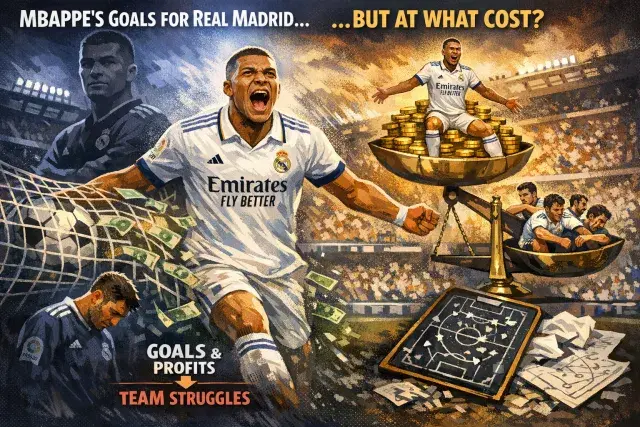
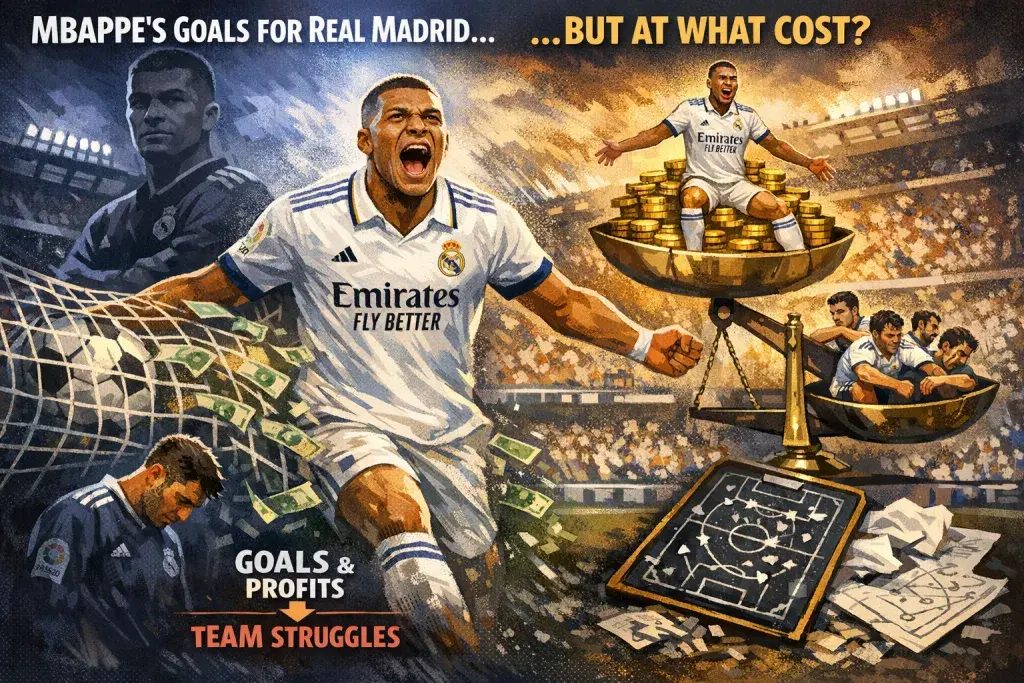
Eighty-three goals across 97 appearances is a number that commands attention. Kylian Mbappe arrived at Real Madrid on a free transfer in 2024 and immediately validated every expectation placed on a generational talent of his calibre. But raw output, however impressive, has begun to obscure a more troubling picture — one in which Madrid's reliance on a single individual has quietly eroded the collective intelligence that made them the most formidable side in European football for the better part of a decade.
Numbers That Flatter, Results That Deceive
For the first half of the current campaign, Mbappe was close to irresistible. Twenty-seven goals before the winter break included a four-goal performance against Olympiacos and the opening strike in a victory over Barcelona that momentarily suggested Los Blancos were building momentum. Comparisons to Cristiano Ronaldo — the defining Bernabeu icon of the modern era — felt earned rather than exaggerated. Mbappe himself responded with characteristic restraint: "I want to follow my own path. Being mentioned alongside Cristiano is already an honour, but I just want to make my own way, help the team, and win as many titles as possible."
The sincerity of that sentiment is now open to question. Since that high-water mark, Mbappe has registered one goal in seven appearances. His shot conversion rate, which stood at 25 percent for the campaign, has collapsed to four percent. In a recent 1-1 draw at home to Girona, his expected goals on target figure was 0.14 — a number that reflects not merely a confidence crisis but a fundamental breakdown in his connection with the system around him. He surrendered possession 20 times in that fixture and won fewer than a quarter of his ground duels. These are not the numbers of a player going through a minor dip. They suggest structural dysfunction.
The Architecture of Dependence
What Madrid's current predicament reveals is not a problem with Mbappe's talent — which remains beyond serious dispute — but with the institutional logic that has formed around it. When a single figure becomes both the creative nucleus and the primary finisher, an organisation surrenders its redundancy. There is no fallback when that figure misfires, no distributed responsibility to absorb the shock of a poor run of form.
The evidence is not subtle. During a six-week spell earlier this year when Mbappe was absent with a knee problem, Madrid won six of seven fixtures, including convincing results against Benfica and Manchester City. In those weeks, Vinicius Junior rediscovered the form that had made him one of the most dangerous wide forwards in world football, Federico Valverde drove forward with authority, and the defensive shape held. The collective mechanism, freed from the obligation to feed a singular ego, functioned with coherence. The moment Mbappe returned and head coach Alvaro Arbeloa reverted to the previous approach, results deteriorated immediately — one point from two fixtures that should have yielded six.
This is not coincidence. It is cause and effect, plainly visible across two consecutive seasons. In Mbappe's debut year, Madrid failed to win a major honour despite his tally of 44 goals. His 31 La Liga contributions that campaign represented close to half of the club's total output — a distribution so lopsided it left them structurally exposed whenever opposition sides successfully negated his influence. They were eliminated from the Champions League by Arsenal, losing 5-1 on aggregate in a tie where Mbappe offered almost nothing of consequence.
The Ego Architecture That Precedes the Numbers
During his final year at Paris Saint-Germain, then-head coach Luis Enrique used an unlikely reference point to make a pointed argument about collective responsibility. Invoking NBA legend Michael Jordan, Enrique emphasised that greatness is incompatible with selective effort — that the most decorated individuals in team environments invariably set the standard defensively as well as offensively. The message was directed at Mbappe. It appears not to have landed.
In March of this year, Mbappe addressed the subject himself on a podcast: "I'm a player who defends a little less than others, and sometimes that can be a problem. It's true that I do it less, but I notice that when I do, it really impacts the team." The framing is telling. Rather than committing to improvement, he positions reduced defensive contribution as an accepted personal characteristic — something he dips in and out of when he sees fit. The implicit argument is that his goal output exempts him from the obligations shared by his colleagues. Organisations that absorb that logic tend to pay for it.
PSG, notably, secured their first Champions League title the season after Mbappe left. Ousmane Dembélé, long regarded as a talented but erratic wide forward, became a relentless defensive contributor under Enrique and was rewarded with the Ballon d'Or. The parallel is uncomfortable for anyone invested in Mbappe's long-term legacy. He has never won the Champions League. He has never won the Ballon d'Or. At 27, with his physical advantages still very much intact, those absences are not accidents of timing. They reflect a pattern.
What Madrid Must Decide
Barcelona currently lead La Liga by nine points with seven fixtures remaining. Madrid face a steep obstacle in the Champions League, having lost the first leg of their last-eight tie against Bayern Munich. The trajectory is clear. The question facing Madrid's leadership is not whether Mbappe is talented — the answer to that is beyond argument. The question is whether a club with the infrastructure, the history, and the depth of talent to operate as a genuinely collective force can afford to continue organising itself around the assumption that one man's brilliance will eventually be enough.
The data from the past two seasons suggests it will not. Mbappe's individual numbers remain elite by any measure. But elite individual numbers, divorced from collective coherence, produce draws against Girona and defeats at Mallorca. They produce near-anonymous displays at Anfield and ineffective performances when the stakes are highest. The ruthlessness Mbappe brings in front of goal is real and rare. The question Madrid can no longer avoid is whether that ruthlessness, on its own terms, is worth the cost of everything it requires them to surrender around it.