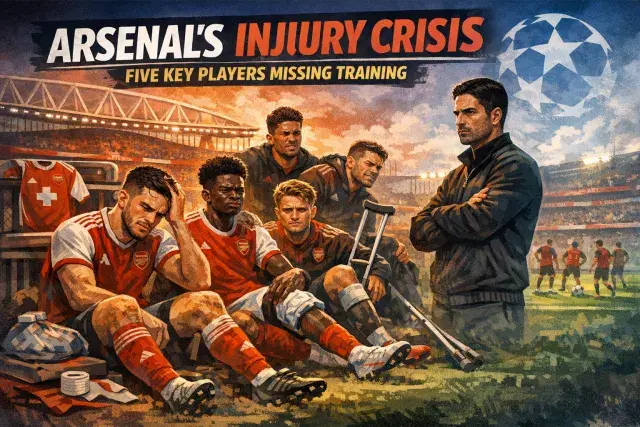
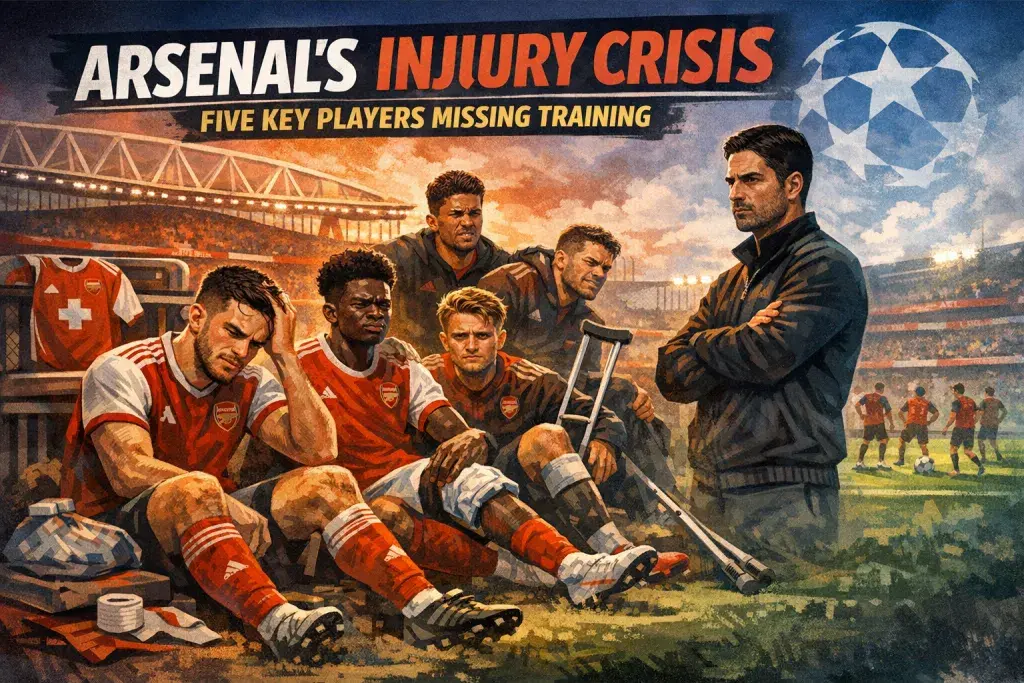
With a narrow one-goal advantage heading into the second leg of their Champions League quarter-final against Sporting CP at the Emirates, Arsenal find themselves confronting a fitness crisis that threatens to undermine months of careful preparation. Five first-team figures were absent from the club's latest open training session, raising serious doubts about the availability of several central figures for what is arguably the most consequential fixture of their European campaign.
A Concerning Quintet: Who Is Missing and Why It Matters
The absences span every layer of the squad. Declan Rice, who completed the full ninety minutes in Sunday's Premier League defeat to Bournemouth, was unexpectedly absent from the training session — a development that caught observers off guard given his apparent fitness just days prior. The nature of his non-appearance has not been formally explained by the club, which in itself compounds the uncertainty surrounding his readiness.
Bukayo Saka remains on the sidelines, continuing a recovery that has already stretched across multiple fixtures. Manager Mikel Arteta had expressed cautious optimism about Saka's return ahead of the Bournemouth fixture, but the winger did not feature, and his continued absence from training suggests the timeline for his return remains unclear. For a wide attacker who has been among the most decisive figures in Arsenal's forward line this season, each passing day of unavailability narrows the margin for his reintegration before the decisive European fixture.
Martin Odegaard, the Norwegian who captains the side, also did not participate in the session. Odegaard has been absent for a spell now, and the creative deficit left by his continued unavailability was visible in the performance against Bournemouth. His technical range — particularly in tight spaces and in the transition between defensive structure and attacking intent — is not easily replicated within the existing squad.
In defence, both Riccardo Calafiori and Jurrien Timber were similarly absent. The Italian centre-back featured for the full ninety minutes in the first leg in Lisbon, but has since been kept away from full training and was omitted entirely from the matchday squad for the Bournemouth fixture. Timber, the Dutch utility defender, suffered a groin injury during a Premier League fixture against Everton last month and has been unable to return to full training since. His versatility — the ability to operate across the defensive line — makes his absence a particular logistical challenge for Arteta in terms of tactical planning.
The Physiological Reality Behind Multiple Simultaneous Injuries
Fixture congestion at the elite level is a well-documented contributor to soft tissue injuries and muscular fatigue. When a squad is required to cycle through high-intensity competitive fixtures across domestic and European calendars with minimal recovery windows, the cumulative physical load on individual bodies increases substantially. There is robust scientific consensus that inadequate recovery time between high-intensity efforts raises the risk of muscular strain, joint stress, and immune suppression — all of which can manifest as the kind of ambiguous fitness issues that clubs often describe, carefully, as "not available for selection."
Groin injuries such as the one affecting Timber are particularly unpredictable in their recovery trajectory. The adductor muscle group, which governs the groin region, is subjected to sharp directional forces during rapid change of pace and lateral movement. Conservative rehabilitation is typically preferred over rushed returns, given the elevated risk of re-injury if a player is returned to full training before the tissue has adequately healed. This explains why Timber's recovery has extended across several weeks without a clear return date being announced.
Strategic Implications With a Critical Fixture Approaching
Arsenal enter the second leg holding a one-goal lead from the first fixture in Lisbon — a position that is advantageous on paper but leaves no room for defensive fragility or creative stagnation. A healthy, settled defensive unit would ordinarily absorb the pressure of holding such a lead with measured composure. The simultaneous absence of two defensive options changes that calculation considerably, forcing Arteta into selections that may not reflect his preferred tactical shape.
The pressure is further intensified by what follows. After the European second leg at the Emirates, Arsenal are scheduled to travel to Manchester City for a Premier League fixture that carries significant implications for the title race. Managing the physical and psychological resources of a squad already stretched thin across both competitions is a test of squad depth, staff capability, and — ultimately — fortune. For a club that has not won the European Cup, sustained deep runs in the Champions League are hard-won and relatively rare. Squandering such an opportunity due to an injury crisis rather than tactical defeat would be a particularly frustrating outcome for supporters and staff alike.
What remains to be seen is whether the absences prove precautionary in nature — managed carefully ahead of the fixture to prevent aggravation — or whether they represent genuine fitness barriers that will leave Arteta with a significantly depleted selection. The club has provided no formal medical updates, which leaves the picture opaque until closer to kick-off.